> ## Documentation Index
> Fetch the complete documentation index at: https://docs.embedchain.ai/llms.txt
> Use this file to discover all available pages before exploring further.
# Slack AI
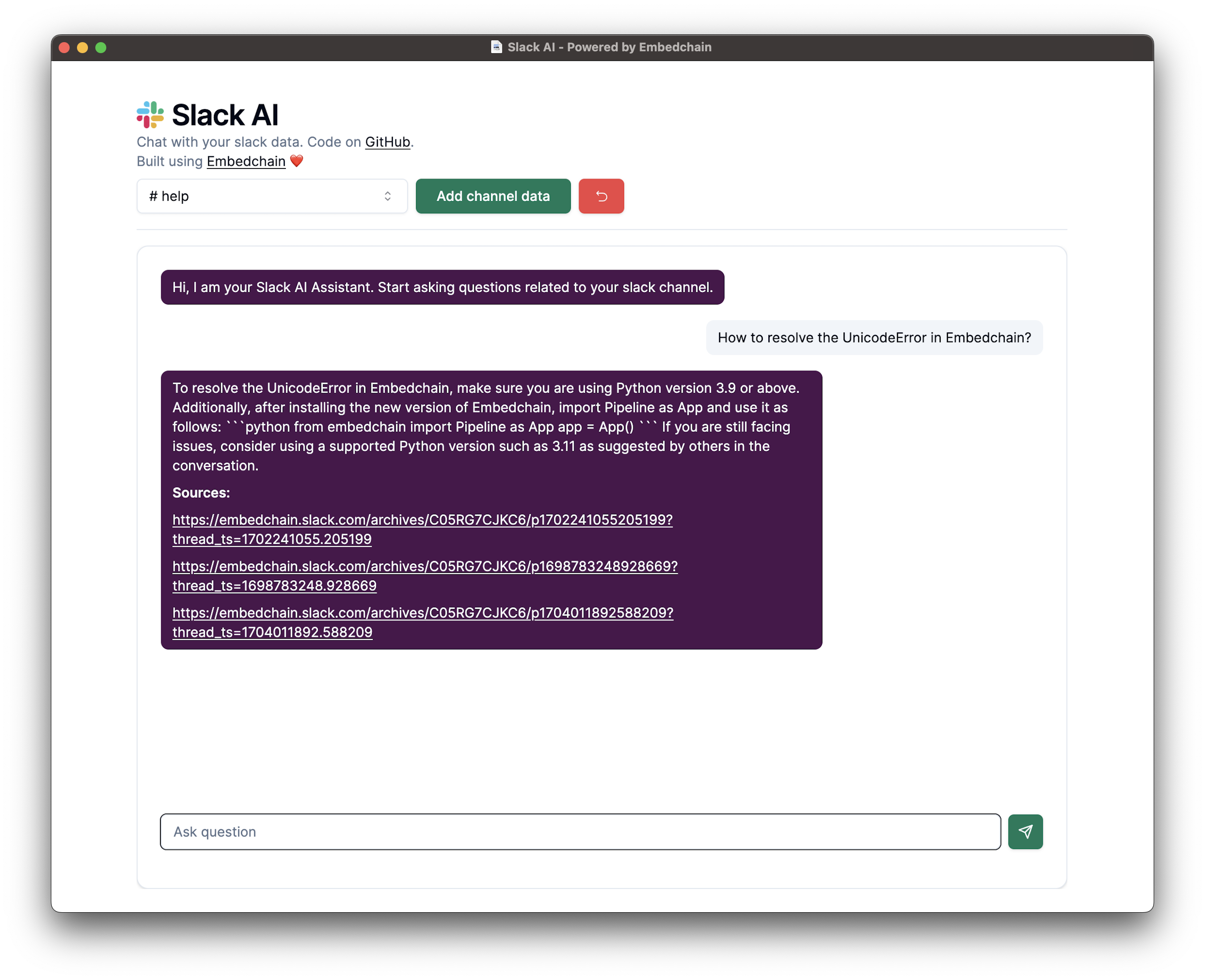
[Embedchain Examples Repo](https://github.com/embedchain/examples) contains code on how to build your own Slack AI to chat with the unstructured data lying in your slack channels.
 ## Getting started
Create a Slack AI involves 3 steps
* Create slack user
* Set environment variables
* Run the app locally
### Step 1: Create Slack user token
Follow the steps given below to fetch your slack user token to get data through Slack APIs:
1. Create a workspace on Slack if you don’t have one already by clicking [here](https://slack.com/intl/en-in/).
2. Create a new App on your Slack account by going [here](https://api.slack.com/apps).
3. Select `From Scratch`, then enter the App Name and select your workspace.
4. Navigate to `OAuth & Permissions` tab from the left sidebar and go to the `scopes` section. Add the following scopes under `User Token Scopes`:
```
# Following scopes are needed for reading channel history
channels:history
channels:read
# Following scopes are needed to fetch list of channels from slack
groups:read
mpim:read
im:read
```
5. Click on the `Install to Workspace` button under `OAuth Tokens for Your Workspace` section in the same page and install the app in your slack workspace.
6. After installing the app you will see the `User OAuth Token`, save that token as you will need to configure it as `SLACK_USER_TOKEN` for this demo.
### Step 2: Set environment variables
Navigate to `api` folder and set your `HUGGINGFACE_ACCESS_TOKEN` and `SLACK_USER_TOKEN` in `.env.example` file. Then rename the `.env.example` file to `.env`.
By default, we use `Mixtral` model from Hugging Face. However, if you prefer to use OpenAI model, then set `OPENAI_API_KEY` instead of `HUGGINGFACE_ACCESS_TOKEN` along with `SLACK_USER_TOKEN` in `.env` file, and update the code in `api/utils/app.py` file to use OpenAI model instead of Hugging Face model.
### Step 3: Run app locally
Follow the instructions given below to run app locally based on your development setup (with docker or without docker):
#### With docker
```bash theme={null}
docker-compose build
ec start --docker
```
#### Without docker
```bash theme={null}
ec install-reqs
ec start
```
Finally, you will have the Slack AI frontend running on [http://localhost:3000](http://localhost:3000). You can also access the REST APIs on [http://localhost:8000](http://localhost:8000).
## Credits
This demo was built using the Embedchain's [full stack demo template](https://docs.embedchain.ai/get-started/full-stack). Follow the instructions [given here](https://docs.embedchain.ai/get-started/full-stack) to create your own full stack RAG application.
## Getting started
Create a Slack AI involves 3 steps
* Create slack user
* Set environment variables
* Run the app locally
### Step 1: Create Slack user token
Follow the steps given below to fetch your slack user token to get data through Slack APIs:
1. Create a workspace on Slack if you don’t have one already by clicking [here](https://slack.com/intl/en-in/).
2. Create a new App on your Slack account by going [here](https://api.slack.com/apps).
3. Select `From Scratch`, then enter the App Name and select your workspace.
4. Navigate to `OAuth & Permissions` tab from the left sidebar and go to the `scopes` section. Add the following scopes under `User Token Scopes`:
```
# Following scopes are needed for reading channel history
channels:history
channels:read
# Following scopes are needed to fetch list of channels from slack
groups:read
mpim:read
im:read
```
5. Click on the `Install to Workspace` button under `OAuth Tokens for Your Workspace` section in the same page and install the app in your slack workspace.
6. After installing the app you will see the `User OAuth Token`, save that token as you will need to configure it as `SLACK_USER_TOKEN` for this demo.
### Step 2: Set environment variables
Navigate to `api` folder and set your `HUGGINGFACE_ACCESS_TOKEN` and `SLACK_USER_TOKEN` in `.env.example` file. Then rename the `.env.example` file to `.env`.
By default, we use `Mixtral` model from Hugging Face. However, if you prefer to use OpenAI model, then set `OPENAI_API_KEY` instead of `HUGGINGFACE_ACCESS_TOKEN` along with `SLACK_USER_TOKEN` in `.env` file, and update the code in `api/utils/app.py` file to use OpenAI model instead of Hugging Face model.
### Step 3: Run app locally
Follow the instructions given below to run app locally based on your development setup (with docker or without docker):
#### With docker
```bash theme={null}
docker-compose build
ec start --docker
```
#### Without docker
```bash theme={null}
ec install-reqs
ec start
```
Finally, you will have the Slack AI frontend running on [http://localhost:3000](http://localhost:3000). You can also access the REST APIs on [http://localhost:8000](http://localhost:8000).
## Credits
This demo was built using the Embedchain's [full stack demo template](https://docs.embedchain.ai/get-started/full-stack). Follow the instructions [given here](https://docs.embedchain.ai/get-started/full-stack) to create your own full stack RAG application.